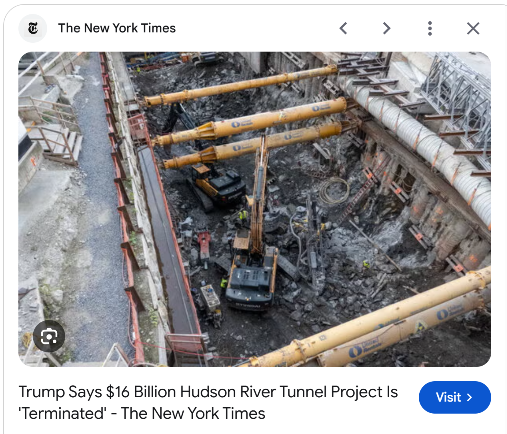
The Gateway Project has not been terminated, but a proposed grants rule could make it easier for the White House to derail Federal infrastructure funding after grants have been awarded.
Last week’s midterm election results brought good news for transit agencies seeking sustainable funding. People across the United States voted in favor of paying for transit improvements through taxes and bonds. The incoming Democratic majorities in the House and Senate have raised advocates’ hopes that Congress will restore $4.2 billion of guaranteed funding that expired in September and expectations that the new Congress will pass a multi-year surface transportation bill more friendly to transit and active transportation.
But, before setting its sights on new frontiers, Congress needs to take care of some unfinished business: putting a stop to a rule that would let political appointees delay, freeze, or cancel virtually any Federal discretionary grant, for transit, research, public health, or anything else, whenever it no longer suits the President’s priorities. Congress has postponed the rule from taking effect once before, but the pause ends on December 11 unless Representatives and Senators take action. Now is the time to let your members of Congress know that we need to protect transit investments from petty politics and the personal vendettas of a lame duck President.
The Politics, and Pettiness, of the Purse
If you’ve studied American government or pay attention to national politics, you’ve probably heard that Congress holds “the power of the purse.” The phrase doesn’t appear in the Constitution, but the principle does: Article I gives Congress the power to tax and spend for the general welfare, and provides that “No Money shall be drawn from the Treasury, but in Consequence of Appropriations made by Law.” Congress sets spending priorities through annual appropriations and multi-year program authorizations.
If you’ve studied constitutional law or follow national legal debates, you’ve probably also heard that the President “shall take Care that the Laws be faithfully executed” (Article II, Section 3). The President can inform legislation before it passes, by recommending measures and submitting an annual budget. Executive agencies often have wide latitude, where Congress grants it, to shape how laws are implemented through regulation and guidance. But once Congress enacts and funds a program for a public purpose, the agency is expected to carry it out.
For the past thirty years, Congress and the White House have periodically engaged in “the politics of the purse” where one political party holds Federal spending and borrowing authority hostage, sometimes shutting down portions or all of the Federal government or risking default on payments, in an attempt to win policy victories. Since the mid-1990s, fights over appropriations and the debt limit have become a recurring tool of political leverage: the Federal government has shut down in whole or part seven times since 1995, including a 35-day partial shutdown in 2018–19, a record 43-day full shutdown in 2025, and a 76-day lapse in Homeland Security funding in 2026, while debt-limit brinkmanship in 2011 and 2023 pushed the Treasury within days of default and cost the U.S. its top credit rating from two agencies.
Historically, it’s been Congress (Republicans or Democrats) that has turned on and off the funding spigot. But now, apparently, two can play at that game. Since 2025, the Trump Administration has used executive orders and policy guidance to delay, withhold, or withdraw congressionally appropriated funds.
On January 27, 2025, a week into the new term, OMB issued a memo directing agencies to pause virtually all Federal grant and loan disbursements while they screened programs for consistency with the President’s executive orders on DEI, “gender ideology,” and the “Green New Deal.” The memo also told agencies to assign a senior political appointee to oversee each program and to cancel awards that conflicted with Administration priorities. The freeze set off immediate chaos, with some grantees locked out of Federal payment systems, and it was temporarily halted by a federal judge minutes before it took effect. OMB rescinded the memo two days later.
Later that year, on the first day of the October 2025 government shutdown, the Department of Energy cancelled roughly $7.6 billion in clean-energy awards. OMB Director Russ Vought pointedly noted that every one of them was in a state that voted for Kamala Harris. A Federal judge ruled in January 2026 that the cancellations violated the Constitution’s equal protection guarantee, and in July DOE stipulated in court that the terminations were “based solely on the political identity of the grant recipient’s state.”
For nearly two years, the White House has circled Federal spending programs like a prizefighter feeling out an opponent — a jab at a funding stream here, a probe at a grant program there, testing which blows land and which draw a penalty from the courts. Some of these blows landed on Federal transit funding.
In March 2025, U.S. DOT ordered a project-by-project review of the roughly 3,200 discretionary grant applications that had been selected for funding under the Biden Administration but not yet fully obligated. Reviewers were directed to flag for potential removal any project that referenced diversity, equity and inclusion, included an equity analysis, or supported bicycle infrastructure, EV charging, greenhouse gas reduction, or environmental justice communities. The effect was a months-long logjam: projects that had been announced, in some cases years earlier, sat in limbo while DOT renegotiated terms, stripped DEI and climate provisions from grant agreements, and cancelled a handful of awards outright. Secretary Duffy assured Congress he would not “hold up any projects,” and DOT has since finalized grants in batches. By June 2025 it reported clearing about a third of the backlog, worth nearly $10 billion, but it has not published a full accounting of how many projects were rescoped, delayed, or dropped.
In the opening days of the October 2025 government shutdown, OMB Director Russ Vought froze roughly $18 billion for New York’s Gateway Hudson Tunnel and Second Avenue Subway extension, then about $2.1 billion for Chicago’s Red Line Extension and Red-Purple Modernization projects, all of them Capital Investment Grant (CIG) projects with signed funding agreements. The stated rationale was a review of whether the projects’ contracting practices involved unconstitutional race- and sex-based preferences, but the timing made the shutdown leverage unmistakable. By early 2026 the Gateway suspension had halted tunnel construction and idled about 1,000 workers, and the CTA warned that Red Line Extension work could stop within days. A Federal judge in Chicago ordered more than $3 billion released in March 2026, and in June a Federal judge in New York ruled the Gateway freeze “contrary to law.” The administration appealed the Gateway decision, then dropped the appeal in September.
Since January 2025, FTA has not signed a single new Full Funding Grant Agreement for a CIG project, the first Administration in more than three decades to go its entire first year without one. Meanwhile, as the New York Times reported this summer, OMB has declined to apportion billions of dollars in CIG funds that Congress appropriated, leaving FTA unable to commit the money even if it wanted to. Projects such as Boston’s Green Line Transformation and Los Angeles’s Southeast Gateway Line have stalled short of the Engineering phase, and congressional Democrats have accused the administration of playing “blue state–red state politics” with the pipeline.
OMB’s Proposed Grants Rule
This spring, OMB wound up a haymaker, proposing a sweeping overhaul to its grants administration guidance found at 2 CFR Part 200. The proposed changes would reach every Federal assistance program across the government, from National Science Foundation research grants and Health and Human Services programs to FTA’s CIG program. OMB offers three stated objectives: “improving transparency, accountability, and oversight for use of Federal funds,” reducing burdens on grant recipients, and converting existing guidance into a binding OMB regulation, so that future changes take effect government-wide without each agency having to adopt them separately.
OMB’s case rests largely on a critique of the Biden Administration, which it says used grant programs to advance a “‘woke’ policy agenda,” attached “a long list of ideological terms and conditions with little connection to the core purpose of public support,” and diverted funding “away from traditional public purposes recognized in law.” The proposed remedy, OMB says, is to “institutionalize needed reforms” so that “every taxpayer dollar the Federal Government spends either improves American lives or advances American interests.”
In reality the proposed guidance would consolidate and centralize the White House’s control over Federal spending, deemphasizing the role of career civil servants in delivering discretionary grant programs and prioritizing the interests, or whims, of the President and his or her political appointees.
Under the proposed rule’s discretionary termination provision, a Federal agency may terminate an award in whole or in part “if the Federal agency or pass-through entity determines that a termination is in the interest of the Federal agency or pass-through entity, including if a Federal award does not effectuate program goals, Federal agency priorities, or the national interest as they exist at the time of the termination” (§200.340(a)(2)).
That final phrase, “as they exist at the time of the termination,” is doing a lot of work. The existing OMB guidance already allows termination if an award “no longer effectuates the program goals or agency priorities,” and this July a Federal judge in Massachusetts ruled that the clause does not let agencies cancel grants based on priorities adopted after the award was made, reasoning that recipients can’t knowingly accept a condition the government can rewrite at will. The proposed rule would close that gap by writing the opposite reading into the regulation itself, and by requiring that the clause appear in every discretionary award
The rule also leaves terms like “program goals,” “Federal agency priorities,” or “the national interest” open-ended and that is no accident. OMB’s preamble says the list of reasons isn’t meant to be exhaustive, defines “agency priorities” as those of the “politically accountable” agency, and acknowledges that those priorities may change “in response to new direction from politically accountable leadership.”
“Politically accountable leadership” could be appointees like the Secretary of Transportation, or it could be the President himself. For the past two years, President Trump has treated his grievances and “the national interest” as one and the same. The President has attempted to terminate Federal projects in order to punish politicians he disagrees with or voters in Democratic strongholds, or as leverage in an attempt to cut deals, to force his opponents to come to him on bended knee or simply to throw his weight around and show them who’s boss.
OMB provided the public with 45 days to comment on the rule, a period criticized as too brief considering the sweeping changes proposed. By the time the comment period closed on July 13, the docket had drawn more than 165,000 posted comments; an independent analysis by researchers Abigail Haddad and Christopher Marcum found that roughly 96 percent opposed the rule, with the political pre-issuance review and expanded termination authority drawing the most fire.
OMB proposed that the rule take effect on October 1, 2026, the start of Fiscal Year 2027. But Congress, it turns out, still has some say. When lawmakers passed a stopgap spending bill in September to keep the government open into the new fiscal year, they included a provision barring OMB from issuing or finalizing its proposed grants rule through December 11, 2026. After December 11, OMB could proceed unless Congress extends the delay or bars the rule outright, and any such measure would need the President’s signature or a veto-proof majority, which is why it would almost certainly have to ride on must-pass legislation.
I can’t predict the future, but I know that the December 11 deadline will be handled by the current Congress in a lame-duck session; the new Democratic majorities in the House and Senate won’t take office until January. And the rule is only one of many items competing for lawmakers’ attention. That’s why advocates need to keep making the case against turning grant programs into instruments of reward and retribution, where funding already committed can be frozen or cancelled because of who governs the city or how a state voted. That’s a principal that transit agencies in red states and blue states alike have reason to defend, because the tools this rule would create won’t belong to any one president.
What’s at Risk: Discretionary Transit Funding
Let’s assume the worst: should the proposed revisions to 2 CFR 200 go into effect, the Trump Administration would use their newfound powers to delay transit applications, cancel existing projects, and/or suspend or withdraw Federal funds already awarded in grants.
Certain categories of funding appear to get a pass. Provisions giving Federal agencies new latitude to suspend or terminate funding are “generally applicable to discretionary awards, but not to Federal awards made under programs where legislation establishes an entitlement to the funds on the part of the recipient, such as block grants, those awarded based on a statutory formula, or disaster recovery grants.” (see § 200.340(e)(4) of the proposed rule). The existing OMB guidance defines a “discretionary award” as “an award in which the Federal awarding agency…selects the recipient and/or the amount of Federal funding awarded through a competitive process or based on merit of proposals…” (2 CFR 200.1 of the current guidance). The proposed rule leaves this definition as is.
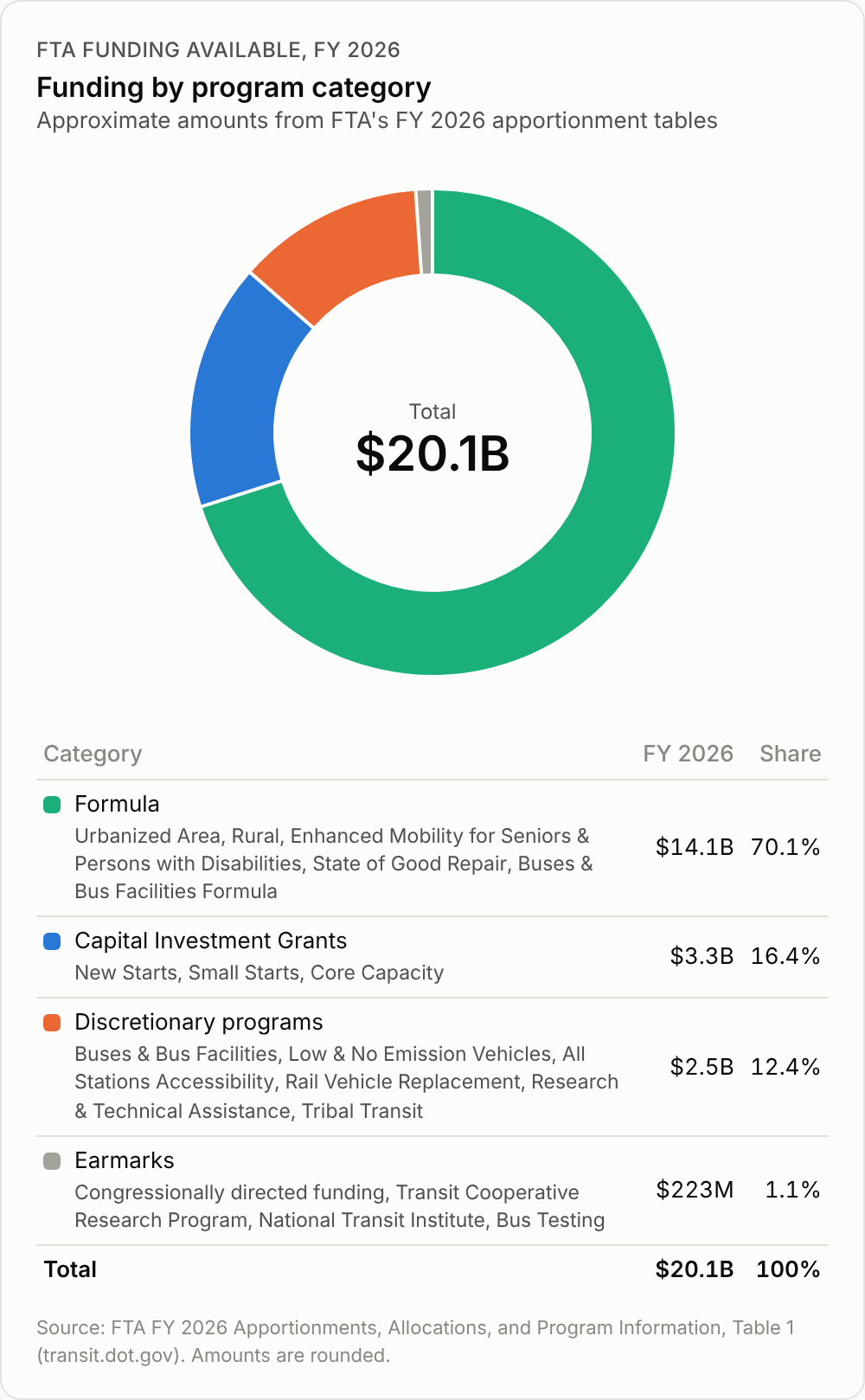
Assuming that transit formula programs and Congressional earmarks would not be impacted by the rule and discretionary programs are fair game, how many programs and how much funding are at risk?
Under the Infrastructure Investment and Jobs Act (IIJA) most Federal transit funding is apportioned under statutory formulas. When it comes to discretionary programs, the Capital Investment Grants program is the most well known, but not the only one. Additional programs include funding for transit on tribal lands, for low- and no-emission buses, accessible rail stations, ferry programs, and research and development.
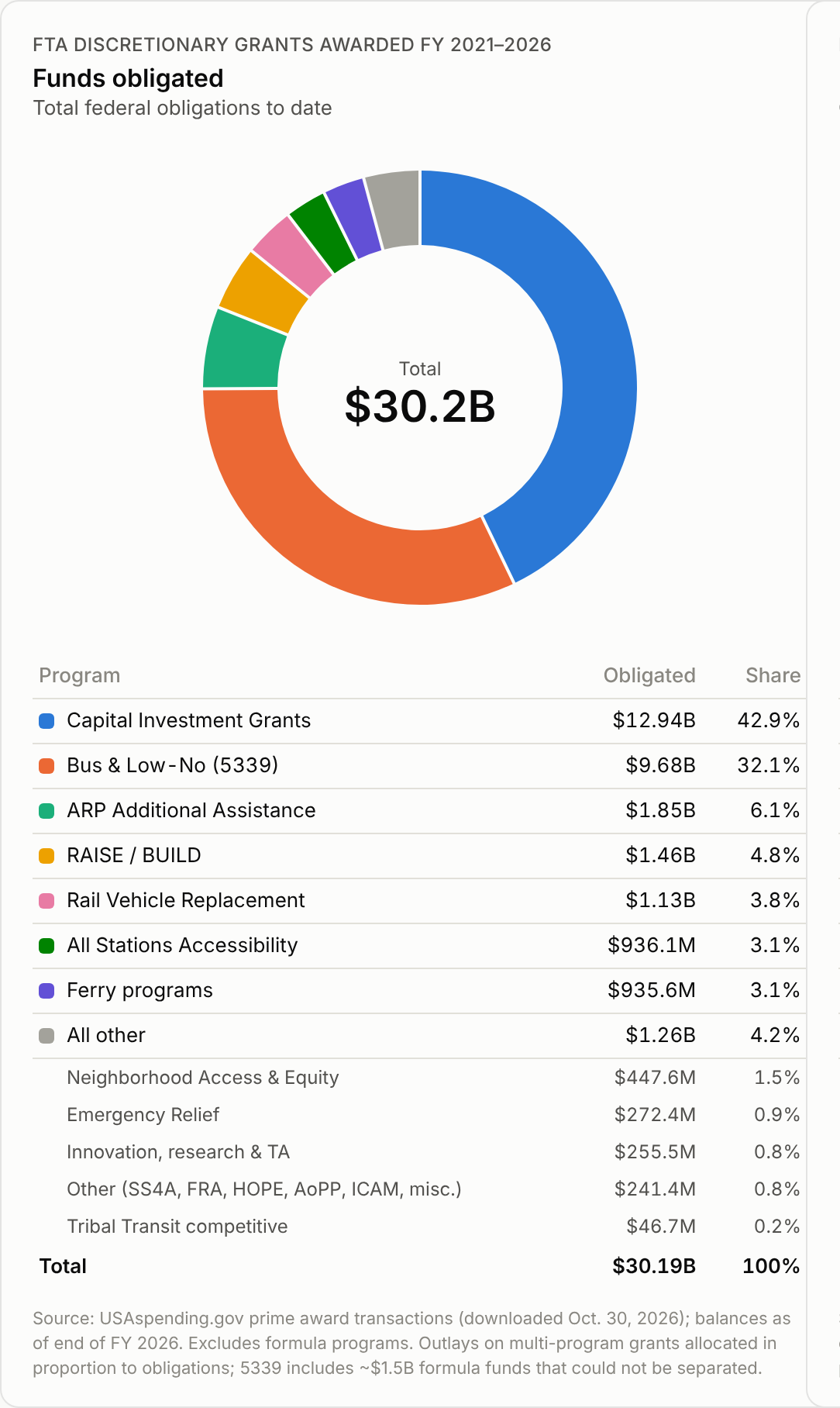
The table below identifies funds awarded in discretionary grants from Fiscal Year 2021 through Fiscal Year 2026, based on publicly available data posted on www.usaspending.gov through the end of October. FY 2021-2024 cover the last few months of the first Trump Administration and most of the Biden Administration. FY 2025 and 2026 cover the remaining months of the Biden Administration and the first portion of the Second Trump Administration. I selected these years because the White House could consider grants awarded under President Biden to no longer be in “the National interest.” I also wouldn’t be surprised if the White House chose to terminate Federal spending made under its own administration in order to score points or attempt to put rivals in their place.
Discretionary grants include programs authorized under the IIJA along with grants funded by separate laws such as the COVID-era American Rescue Plan or emergency relief appropriations. Identifying funds obligated in discretionary grants is surprisingly tricky. In most cases, the Assistance Listings program number and description identify the specific program funding an award, which can be sorted into formula, earmark, or discretionary programs. However, some discretionary grants are associated with formula program Assistance Listing numbers and some grants include both formula and discretionary funding. Ultimately, after relying on several different indicators, I arrived at the information shown below. You can review grant-by-grant information here.
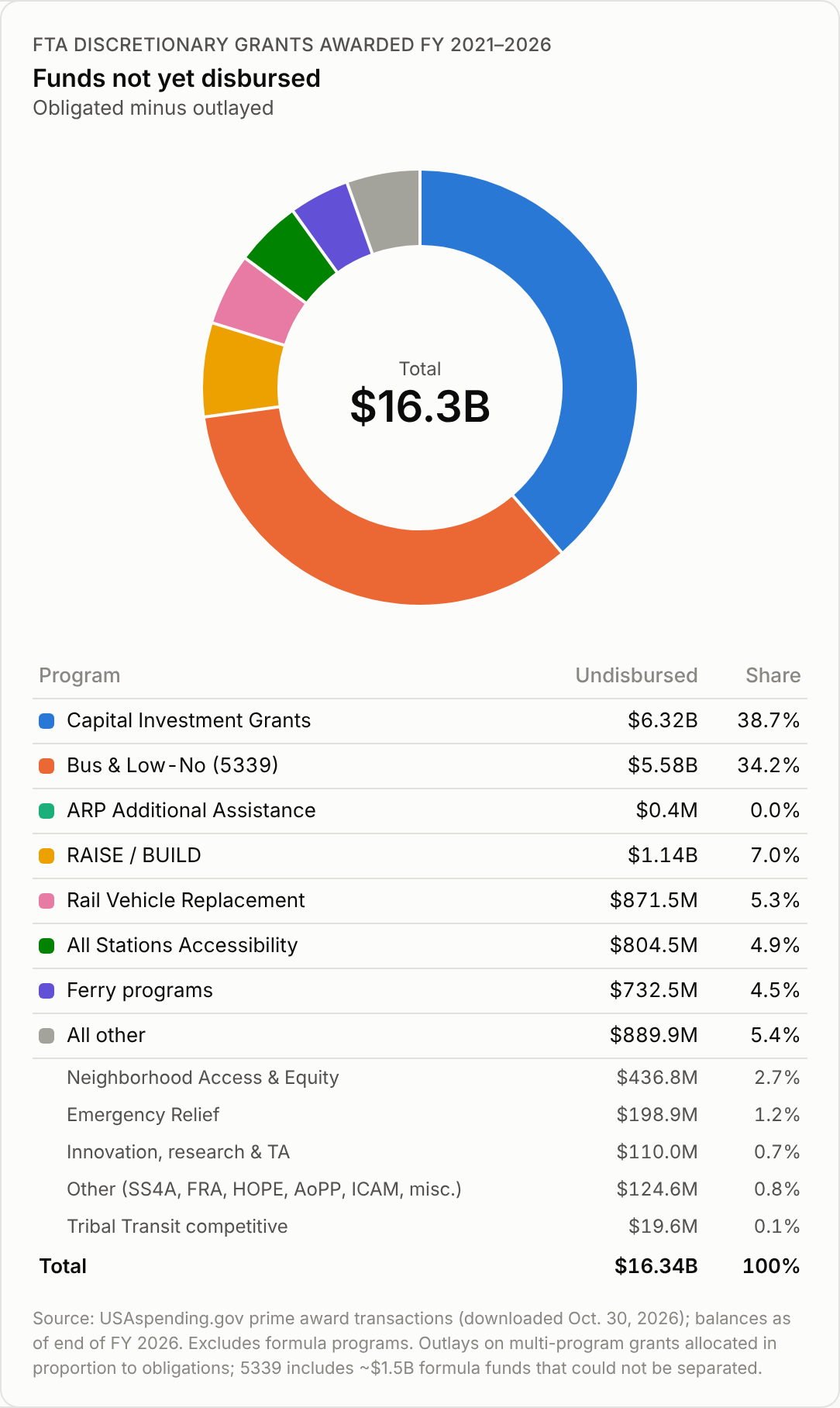
Publicly available data also identifies total awarded funds that have been disbursed (i.e. paid to the grant recipient) as of the end of October. Subtracting disbursed from awarded funds leaves the amounts remaining in the Federal treasury that could be suspended or removed. The table below shows the breakout:
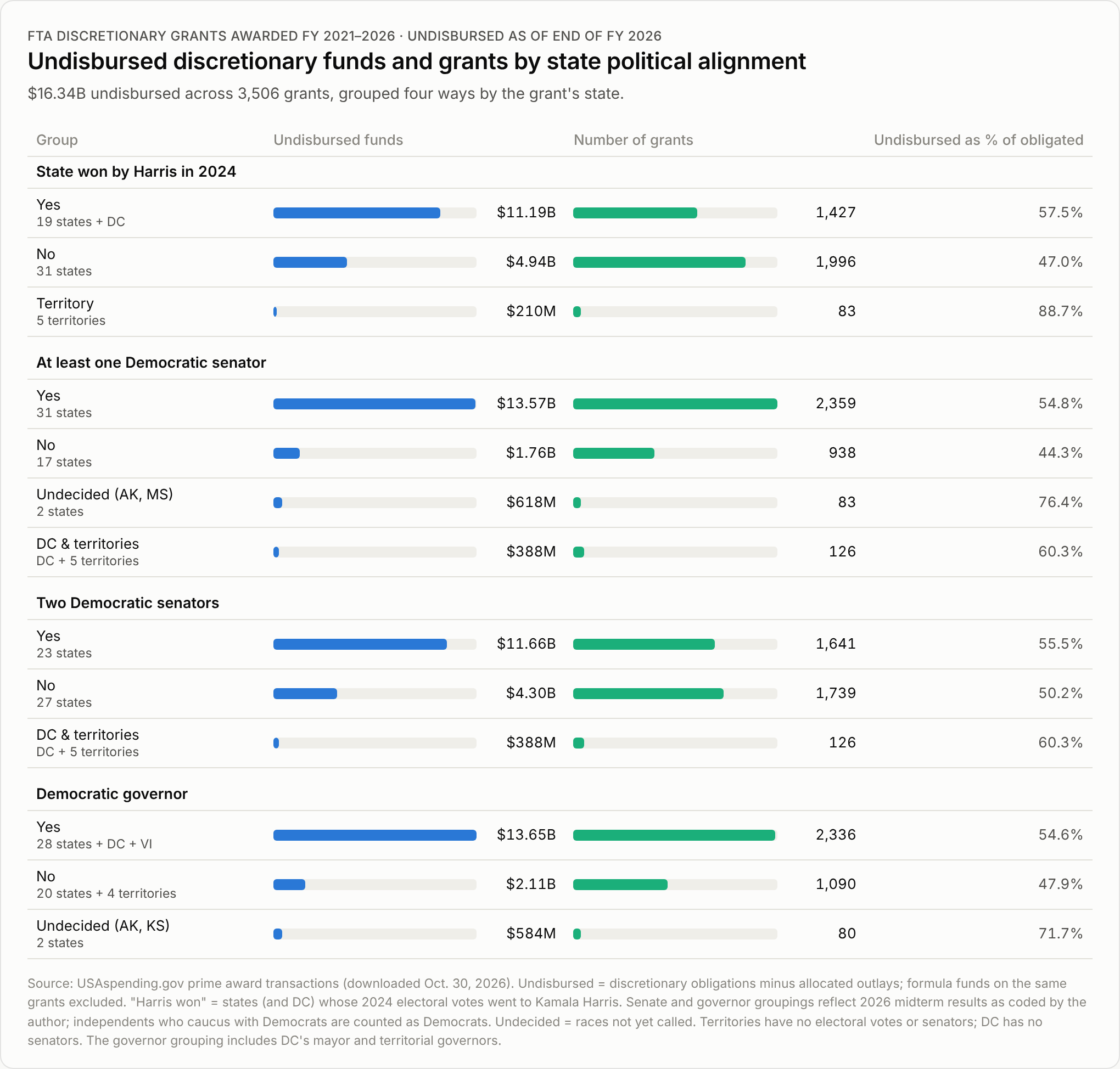
The Proposed Rule Empowers Trump Appointees to Cancel up to $13 billion for Transit in “Blue States”
I had difficulty writing that header. I don’t do much partisan blogging and try to avoid “crying wolf.” And yet, given the Trump Administration’s admission that they canceled Department of Energy grants in states that voted for Kamala Harris and given their track record of suspending payments for transit mega projects in the very blue cities of New York and Chicago, it is worth contemplating the possibility that additional projects would be stalled or killed.
The chart below, which takes into account the results of last week’s midterm elections shows transit projects funded by discretionary programs in four categories: projects in states that Kamala Harris won in 2024, projects in states with at least one Democratic Senator, projects in States with two Democratic Senators, and projects in states with a Democratic Governor.
These grants aren’t just lines on a chart; they represent tangible investments in American infrastructure that will benefit communities, large and small, across the United States. We know this because each application is required to summarize the purpose, activities, intended outcomes, and beneficiaries of the projects in the grant, and this information is made available to the public via www.usaspending.gov (For more information on how these narratives could be used to evaluate results as well as expectations, see my post: Closing the Loop: Finding Out What Transit Actually Delivered).
Here’s a tiny sample of the work being funded by discretionary grant programs across the United States:
—The City of Detroit, MI was awarded $86.1 million in July 2026 to replace 87 aging diesel buses, with newer diesel and hybrid-electric vehicles. The grant, made under the Low and No Emission Vehicle Discretionary Program, will result in cleaner and more cost-effective bus service. As of November, no funds have been disbursed.
—The Southeastern Pennsylvania Transit Authority (SEPTA) in Philadelphia received $317 million in January 2025 under the Rail Vehicle Replacement discretionary program to replace aging subway cars along the Market-Frankford Line. The new rail cars will be cleaner and safer to operate and will improve service reliability. To date $311 million remains undisbursed.
—The Massachusetts Bay Transportation Authority (MBTA) in Boston, MA is replacing the North Draw One Bridge over the Charles River and received a $472 million award (part of a series of awards for this project) in 2025 under the MEGA Discretionary Grants Program. The project would provide six new tracks across the river, expanding rail capacity by 50% and creating more frequent and reliable commuter rail, and freight rail service. So far $411 million of the $472 million is undisbursed.
—The Metropolitan Area Transit Authority (MARTA) in Atlanta, GA received $25.3 million under the Buses and Bus Facilities Discretionary Program for a new bus transfer hub in South DeKalb. The facility would provide a dedicated transfer point and mean fewer riders have to cross a busy and dangerous road to catch the bus. It would also include restrooms, a break area for bus operators and real-time arrival information and covered waiting areas. Almost 99% of the funds are undisbursed.
If an agency decides a discretionary grant no longer serves “Federal agency priorities, or the national interest,” the proposed rule requires the agency to provide little more than a written notice to the recipient with “a brief summary” of reasons and an invitation to submit a certified accounting of wind-down costs, which the agency may or may not pay. A 90-day stop-work order requires no stated reason at all. And there is no administrative appeal: the rule expressly exempts discretionary terminations from the hearing rights that apply when a grantee is accused of noncompliance, pointing aggrieved recipients instead to the Court of Federal Claims, a venue that can award damages but generally can’t put a transit project back under construction.
In addition to depriving the public of promised transit investments, suspending payments and terminating grants would put transit agencies in a serious financial bind. By the time funding is suspended or terminated, grant recipients in Detroit and Philadelphia may have already signed binding contracts for new buses or rail cars. Transit agencies in Boston and Atlanta may have committed to pay construction contracts. There is typically no other source of funds that can replace such large Federal commitments. The likely outcome, as we saw in the case of the New York and Chicago payment suspensions, is lawsuits brought against the Federal government, legal fees, and increased project costs due to delay.
The Proposed Rule Could Delay and Further Politicize Discretionary Funding Competitions
Suspending payments to discretionary transit projects or cancelling them outright would be the most severe but not the only adverse consequence of language in the proposed rule. Another provision could make it more difficult to select discretionary transit projects for funding by adding an extra level of political scrutiny to the process.
According to the proposed rule: “OMB proposes to revise § 200.205 to strengthen requirements for agency merit review and to establish a new pre-issuance review process consistent with Executive Order 14332. Under the proposed requirements for pre-issuance review, as part of the broader merit review process, agencies must ensure that proposals selected for funding are consistent with applicable law, Federal agency priorities, and the national interest. Consistent with the Executive order, senior appointees must conduct these reviews and apply specific principles when evaluating proposals. These principles include ensuring that discretionary awards advance the President’s policy priorities…” (emphasis added).
Transit discretionary project selection adheres to a multi-step process described in the existing OMB guidance. This step includes publishing a Notice of Funding Opportunity (NOFO) that announces Federal funding available under specific program(s), describes eligible activities, provides instructions to potential applicants, and describes criteria for evaluating proposals. Typically, teams of civil servants review each proposal and rate it against the criteria established in the NOFO and recommend some proposals to agency leadership for funding. Agency leadership then sends the results to the Office of the Secretary of Transportation which reviews and weighs in on the project selections. Once these reviews are completed, an agency announces the selected projects. After that, the recipient and FTA still must develop and review a formal grant agreement before Federal funds are officially committed for the project.
The table below, based on publicly available information from Federal Register Notices, PowerPoint presentations, and FTA press releases summarizes the project selection status of transit discretionary projects from Congressional appropriation to project announcement (excluding the Capital Investment Grant Program, which follows a separate process) as of early October 2026
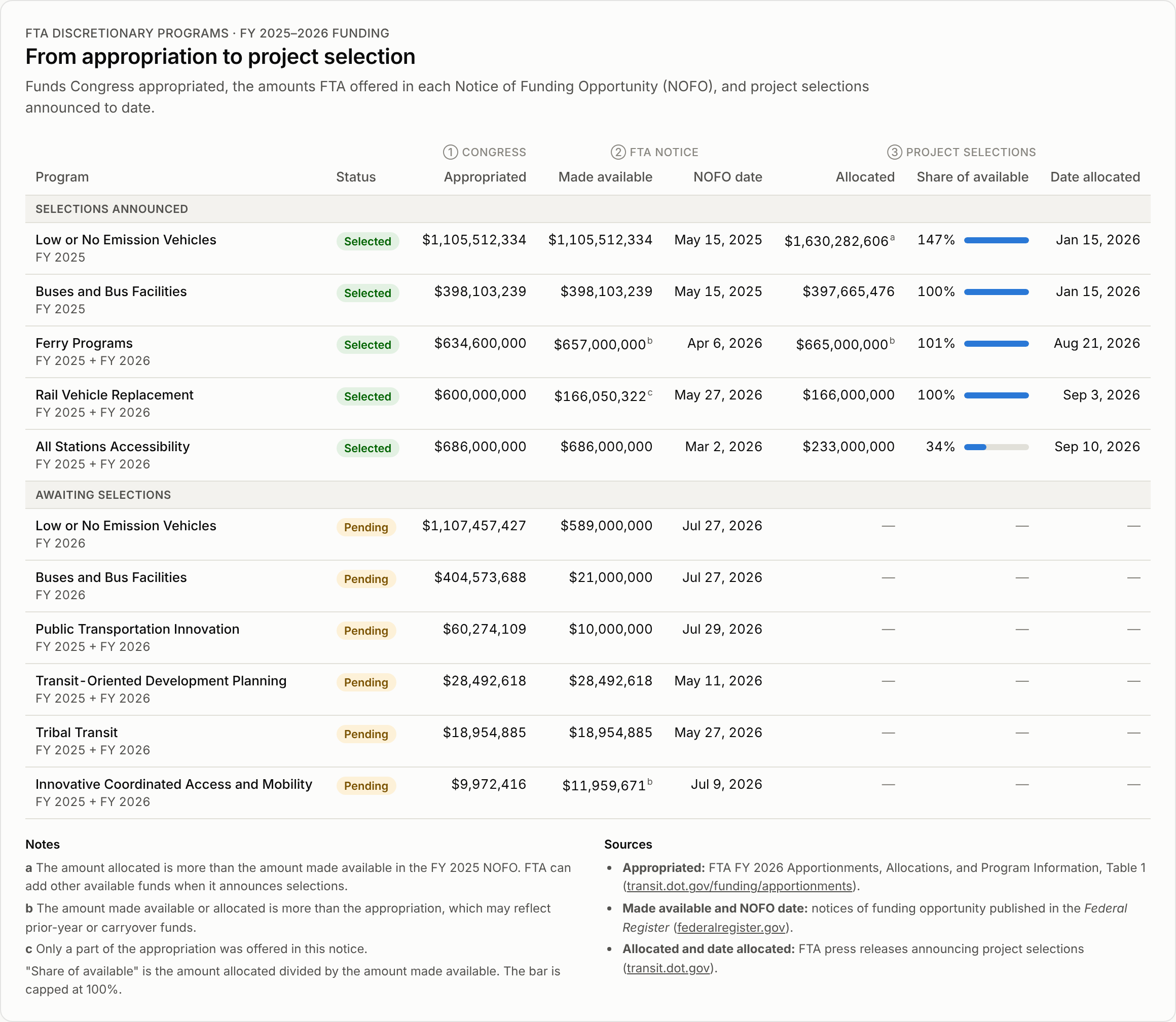
Taken together, these programs suggest a long road from appropriation to award. Measured from October 1, 2024, the first day of fiscal year 2025, FTA announced project selections for the FY 2025 Buses and Bus Facilities and Low and No Emission Vehicles programs about 15½ months later. Selections for the Ferry, Rail Vehicle Replacement, and All Stations Accessibility programs, which combined FY 2025 and FY 2026 funds, came 22 to 23 months after the start of FY 2025. Some of this delay has reasonable explanations. Combining two years of funding into a single competition can save time and effort for both FTA and applicants. And Congress rarely enacts full-year appropriations by October 1, so the exact amounts are often not final until months into the fiscal year. Even so, funding levels for these programs are largely set in advance by the IIJA. Federal agencies, including FTA in some years, also routinely issue funding notices before appropriations are final, on the condition that actual amounts may change once Congress acts.
The above table also raises some questions: why was only $166 million out of $300 million in Rail Vehicle Replacement Fund announced in May 2026? Why was only $232 million out of $686 million in funds available by Congress for the All Stations Accessibility program committed to projects in September? FTA’s NOFOs and press releases on these programs do not provide an explanation.
The US DOT’s standard process for reviewing and selecting discretionary transportation projects already includes a step for political appointees in the Department’s modal administrations and Office of the Secretary of Transportation to review and weigh in. Under the best-case scenario, this process would simply continue. On the other hand, the rule could result in additional political Trump appointees who work at US DOT and/or at OMB to review and sign off on each discretionary program selection, a review process that brings additional opportunities to ignore or deemphasize non-partisan project review and instead reward friends and punish political foes by selecting or denying transit projects to their cities, states or Congressional districts.
The Proposed Rule Could Make It Harder for Federal Funding to Flow to All Transit Projects
Buried in the Federal Register notice (91 FR 32254 (§ 200.305(c)) is a provision that seems innocuous but could add a significant burden to the day-to-day process of funding transit projects (along with any publicly funded work).
“OMB also proposes language that requires payment requests from recipients and subrecipients other than States to include justifications describing the purpose of the payment and the specific award-related work it supports. Under the proposed text, agencies must collect this information once appropriate systems are in place. These proposed changes would increase accountability for Federal disbursements while ensuring funds are tied to measurable award activities and outcomes.”
Unlike other portions of the rule which apply to discretionary grant programs, this provision appears to pertain to all types of Federal funding. On any given day, hundreds of payment requests for millions of dollars are processed through the Federal payment system.
The diagram below shows what happens behind the scenes for a transit agency or other funding recipient to be reimbursed for expenses incurred. Once a grant is awarded and executed in FTA’s Transit Award Management System, a recipient can make payment requests for eligible activities via the Electronic Clearinghouse (ECHO). This triggers payments from the U.S. Treasury to the Recipient’s bank account.
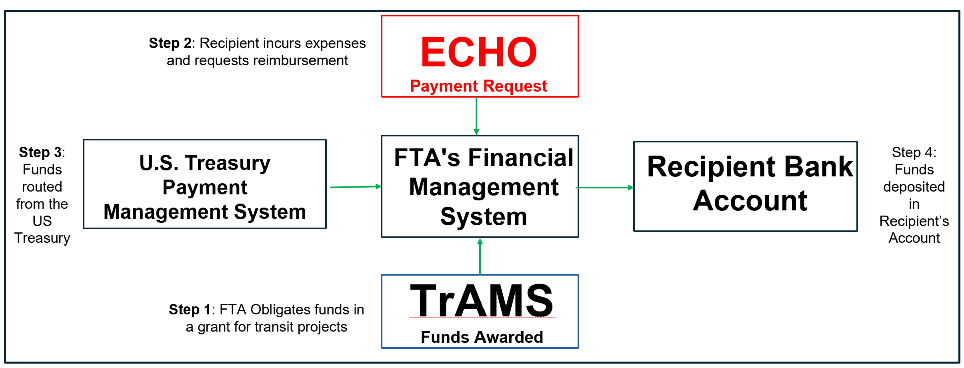
Right now, funding recipients do not need to submit supporting documentation each time they request a payment. This documentation needs to be kept on file and is typically audited once every three years as part of FTA’s oversight. Additional information about milestones met and funds expended are submitted in progress reports due annually or quarterly (depending on the transit program and funds awarded in the grant).
Adding a requirement to upload a payment justification creates additional paperwork for transit agencies that is hard to reconcile with the proposed rule’s stated goal of “reducing recipient burden” (Federal Register page 32202).
Once a recipient submits a payment request, someone, or something (an FTA employee, contractor, or Artificial Intelligence agent) will probably need to review and approve the documentation before a payment request can be processed. What might be a handful of submissions per day for an individual agency can become hundreds of submissions to review per day for US DOT. Using AI to review and approve millions of dollars in payment requests raises questions about what government functions should be automated and how humans will be in the loop (if at all). Employing contractors means additional taxpayer-funded expenses and using Federal employees would result in a significant workload increase for an agency that has lost hundreds of employees to voluntary early departures offered during the DOGE era and subsequent attrition. None of this is efficient.
Here’s What You Can Do
Widespread opposition to the proposed rule has continued beyond this summer’s public comment period. The National Council of Nonprofits has issued a national letter urging Congress to permanently block the rule. So far over 2,000 organizations have signed on. November 10 is a National Day of Action to call or email your Senators and Representatives and post messages on social media encouraging Congress to make this fall’s temporary suspension permanent.
Over the longer term, Congress could explore alternatives to discretionary programs that would improve predictability, speed project delivery and mitigate the risk that politics delays or derails transit projects. Urban Institute scholar Yonah Freemark explores turning to Federal tax credits to fund large scale transit projects currently funded by the CIG program. (see Could A Tax Credit Offer A Better Way To Fund New Transit Lines?).
Ultimately, the OMB proposed rule is just one front in a series of steps that the Trump Administration has taken to wield power under the Unitary Executive Theory, an idea which holds that Article II, which vests “the executive Power” in a single President, gives the President complete control over the entire executive branch, including the power to direct how agencies carry out the law and to remove the officials who run them. Its most expansive advocates, including OMB Director Russ Vought, go further, arguing that the President has inherent authority to decide whether and how money Congress appropriates is actually spent. New majorities in Congress give the legislative branch new opportunities to assert its constitutional powers of the purse, exercise its oversight authority and remind the President that he or she must take care that the laws be faithfully executed. The Constitution put Congress in the driver’s seat on spending; its time lawmakers took back the wheel.
