Closing the Loop: Finding Out What Transit Actually Delivered
Reauthorization! This word sharpens the minds and stirs the spirits of surface transportation policy wonks everywhere. Unlike the annual (often delayed) budget bills that Congress uses to dole out cash for highways, rail, and public transportation, reauthorization legislation sets the law that establishes federal transportation programs, defines their purposes, sets their structure, authorizes Congress to spend money on it up to certain levels, and writes substantive policy.
2026 is a “reauthorization year” meaning that Congress needs to enact a new surface transportation bill, or extend the current one, which was enacted in 2021, in order for new transportation funding to flow to states and cities. This year also offers people seeking to shape transportation policy a small window to try to get their proposals enacted in law.
To date, a key House of Representatives Committee has passed the BUILD America 250 Act (HR 8870), a five-year, roughly $580 billion reauthorization bill. On the Senate side, Senators have not yet announced a timeline for delivering their version of the legislation. The finish line where both chambers pass bills that are reconciled and signed into law is not yet in sight.
The reauthorization processes’ incremental and relatively leisurely pace has given transportation industry stakeholders and other interested parties plenty of time to weigh in on what they see, so far. Most of the attention has focused on funding levels, regulatory streamlining, program structure and, to a lesser extent, accountability for how projects are selected or managed. Our current discussion reminds me of the surface transportation policy conversations I participated in during my 20+ years as a civil servant with the Federal Transit Administration where perennial fiscal questions of: “who gives” and “who gets” are front and center. At the same time, people are not asking a foundational question about policy and the public good: do all this money and all these rules actually make a difference in people’s lives?
Buried in the U.S. Code's declaration of purpose for the federal transit program is a promise that nobody in this reauthorization debate is talking about: Federal support exists, in the law's own words, "to deliver high quality service to all users, including individuals with disabilities, seniors, and individuals who depend on public transportation." It's a sweeping commitment, with little follow-up to understand the actual quality of services provided in hundreds of communities across the United States.
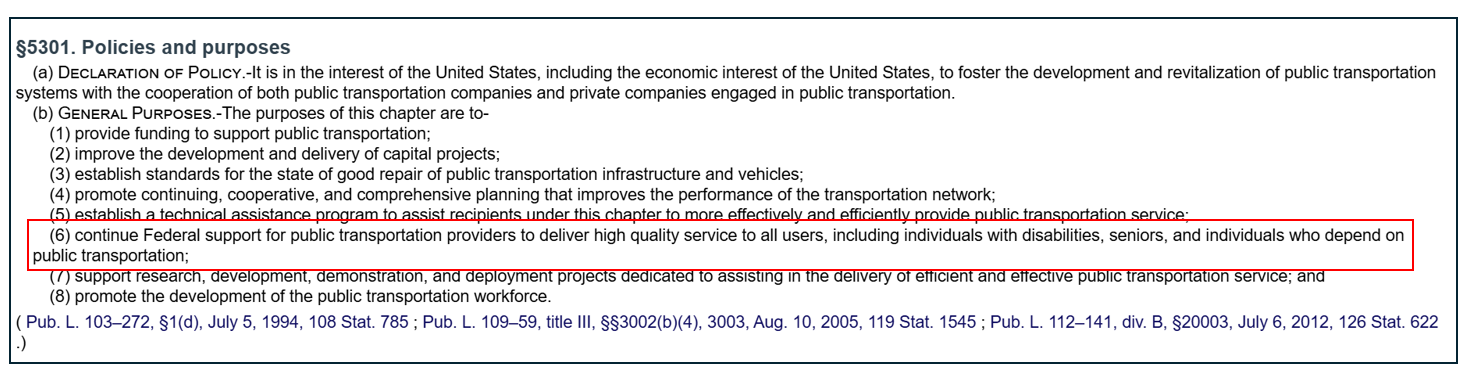
The reauthorization process now underway is a rare opportunity to close that gap by asking the people who run the projects to do something federal grant recipients are already required to promise at the outset and almost never required to revisit: to say, honestly and on the record, whether they did what they said they'd do, and what they learned along the way.
Since 2020, Federal guidance has required every grant recipient to publicly state, at the time of award, what the grant is for, what activities it will fund, what outcomes are expected, and who the intended beneficiaries are. The rule was designed to make federal spending more transparent. And, whether intentionally or not, it created a baseline. My reauthorization proposal would ask recipients to return to that baseline at grant closeout, to reflect on the work that was completed, and answer a simple set of questions: did we do what we said we'd do, did it work, why or why not, and what did we learn? This would not require more federal audits, new reporting systems, or expensive evaluation contracts. It would mean trusting the transit manager who ran the project — and who already knows whether the frequency improved, whether the passengers showed up and whether contracts were completed on time — to write that knowledge down before it disappears.
Begin with the End in Mind
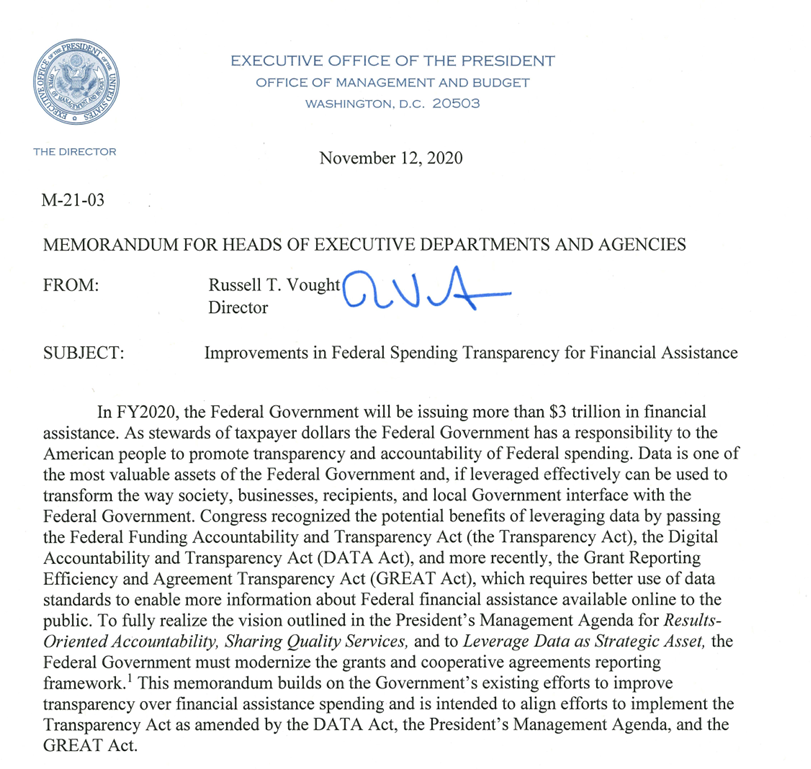
The first paragraph of OMB Memo M-21-03
On November 12, 2020, the White House Office of Management and Budget issued memorandum M-21-03, "Improvements in Federal Spending Transparency for Financial Assistance." Given everything else going on at the time (a global pandemic, a contested Presidential election) I wouldn’t blame you if you missed it. The memo was signed by Russell Vought, the OMB Director during the first and second Trump Administrations. In between terms, he made plans to put Federal workers “in trauma” should President Trump win again.
Be that as it may, the OMB M-21-03 is not an effort to force out bureaucrats and dismantle the deep state. If anything, it improves the integrity of Federal spending programs by insisting that grant recipients explain how taxpayer dollars are used. The Memo states that agencies must use “strong award descriptions" — descriptions that avoid acronyms and federal or agency-specific terminology and include plain-language descriptions of the purpose of the award and the intended beneficiary or recipient.” Additional guidance from OMB clarified that strong award descriptions include the purpose of the Federal financial assistance, award specific activities, and intended beneficiaries.
In October 2021, the Biden Administration replaced M-21-03 with updated guidance, “OMB M-22-02, "New Financial Assistance Transparency Reporting Requirements” which carried forward the requirement to provide strong award descriptions and required that additional information, such as a period of performance end date, also be made available to the public.
President Trump has revoked at least 78 previous Executive Orders to date, but the Federal spending transparency orders have not been among them. I do not believe this is an oversight. The framework underlying these guidance documents is genuinely bipartisan, built across five administrations and nearly two decades and rooted in law, not just agency memos. It begins with the Federal Funding Accountability and Transparency Act of 2006, signed by President George W. Bush, which required that every federal award be disclosed on a publicly searchable website, www.usaspending.gov. The DATA Act of 2014, signed by President Obama, standardized the data so it could actually be compared and analyzed. The OMB guidance that followed — including M-21-03 under Trump and M-22-02 under Biden — refined that disclosure means a plain-language account of what the money is for, what activities it will fund, and who the intended beneficiaries are.
Running alongside this transparency architecture is a parallel set of requirements for performance evaluation. The government-wide Uniform Grants Guidance, codified at 2 CFR Part 200, requires federal awarding agencies to measure recipients' performance, share lessons learned, improve program outcomes, and foster adoption of promising practices — and it requires that performance reporting focus specifically on intended program outcomes, not just activities completed.
In the years since M-22-02 was issued, Executive Branch agencies, including the U.S. Department of Transportation have updated their grants infrastructure to implement the more robust grant award narrative requirements. FTA updated its Transit Award Management System (TrAMS) IT platform to require every grant application to provide succinct awards narratives.
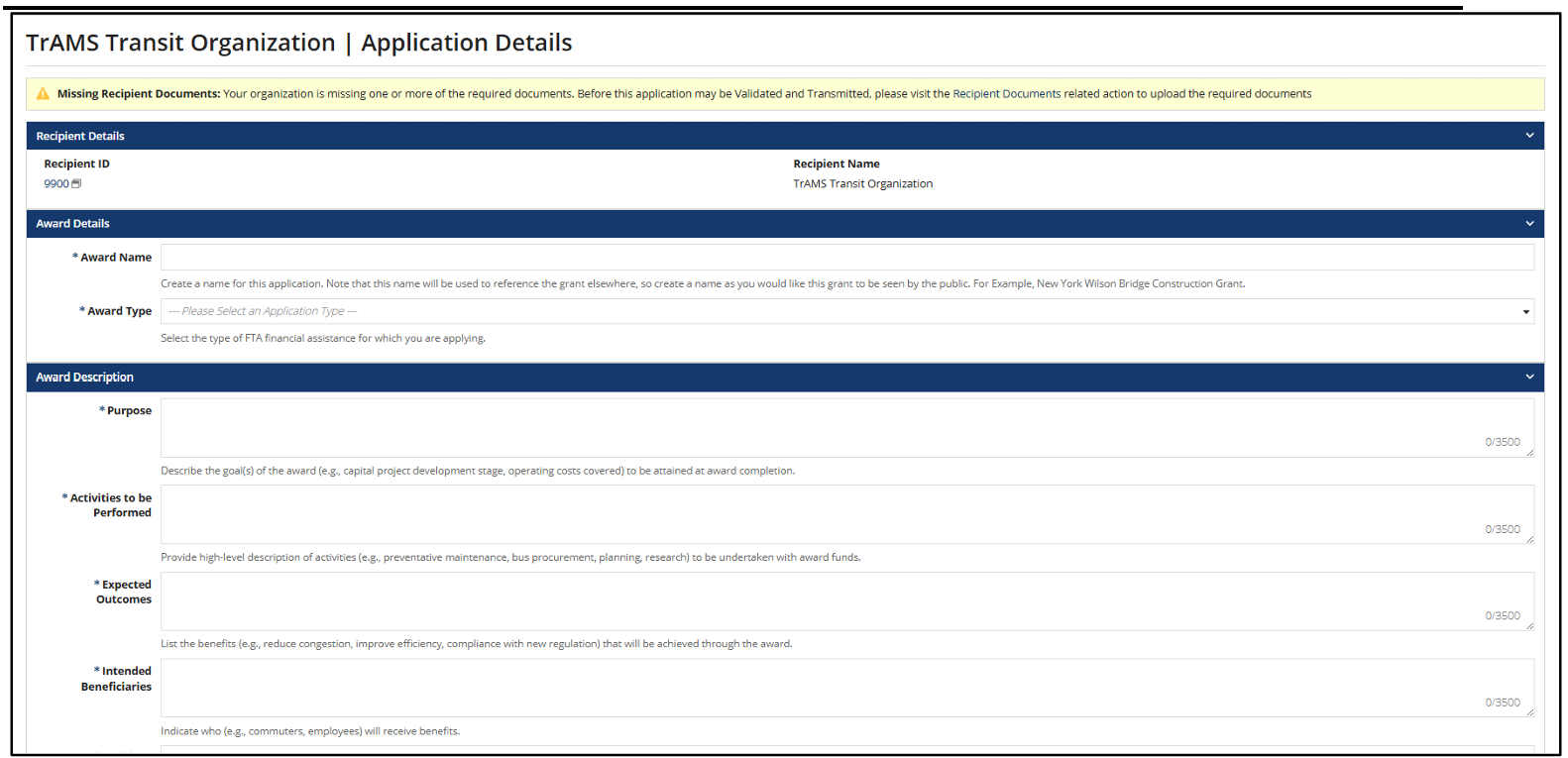
Transit agencies and other grant recipients typically create and transmit applications anywhere from a few weeks to a few months prior to grant award so the narratives reflect transit planner’s expectations for work that will take place in the future (an exception is when a grant recipient is using “pre-award authority” a concept that allows agencies to start projects prior to receiving Federal funding, spend their own funds first, and then be reimbursed after award). Once awarded, the narratives are automatically posted to www.usaspending.gov and visible to the public, typically a week or two after federal funds are obligated.
Ultimately, anyone with internet access and an interest in public finance can go to www.usaspending.gov and learn about how grant recipients plan to put taxpayer funds to work. Here is just one example of thousands.
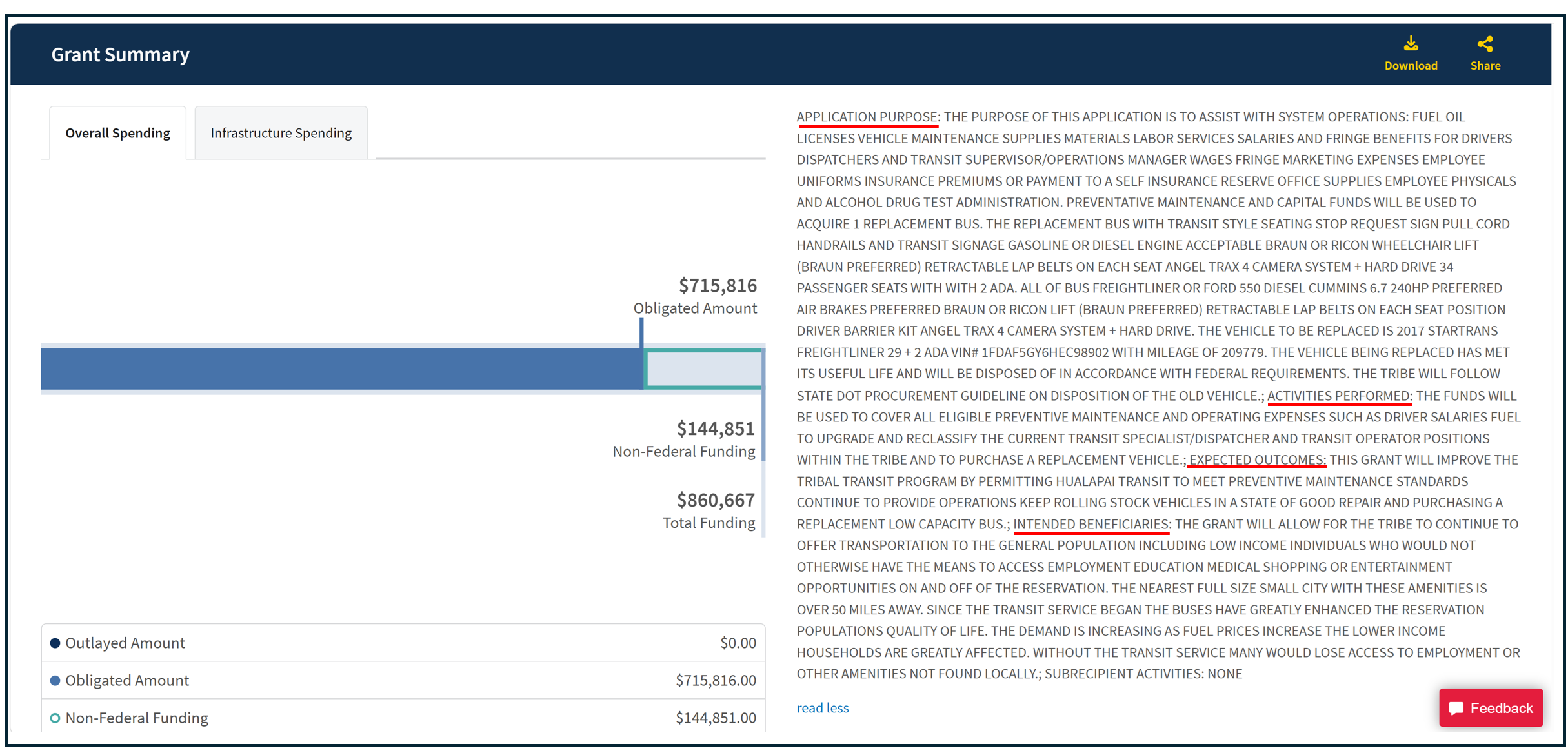
An example of an award narrative from the Hualapai Tribe, one of dozens of Native American tribal transit providers that receive Federal grants annually to serve their communities.
Great Expectations
A federal memo required strong award descriptions. A grants management IT platform added fields to collect them. Those fields are now populated by thousands of transit agencies and published automatically on a public website where anyone can read them. What began as a transparency requirement has quietly become a national dataset, hidden in plain sight. Before making the case for what should happen at grant closeout, it's worth understanding what the ex ante half of the framework is already telling us. If the award narrative is a public promise, what, in aggregate, is the federal transit program promising? With some help from Claude Code, I performed some natural language processing to learn more.
I started by parsing out labeled sections (purpose, activities, outcomes, beneficiaries) embedded in the award narratives, then removed duplicate entries to arrive at a clean working set of roughly 8,700–9,000 grants awarded from 2022, when the new narrative structure took effect, through mid-2026. For each field, I converted the text into numerical vectors using TF-IDF (term frequency–inverse document frequency), which weights words by how distinctive they are to a given narrative rather than how often they simply appear — this keeps generic grant language like "funding" or "transit" from drowning out more meaningful terms
From there, I used a technique that automatically groups similar narratives together based on shared vocabulary, sorting the thousands of award descriptions into a handful of recurring themes. Each award was then assigned to whichever theme its language matched most closely.
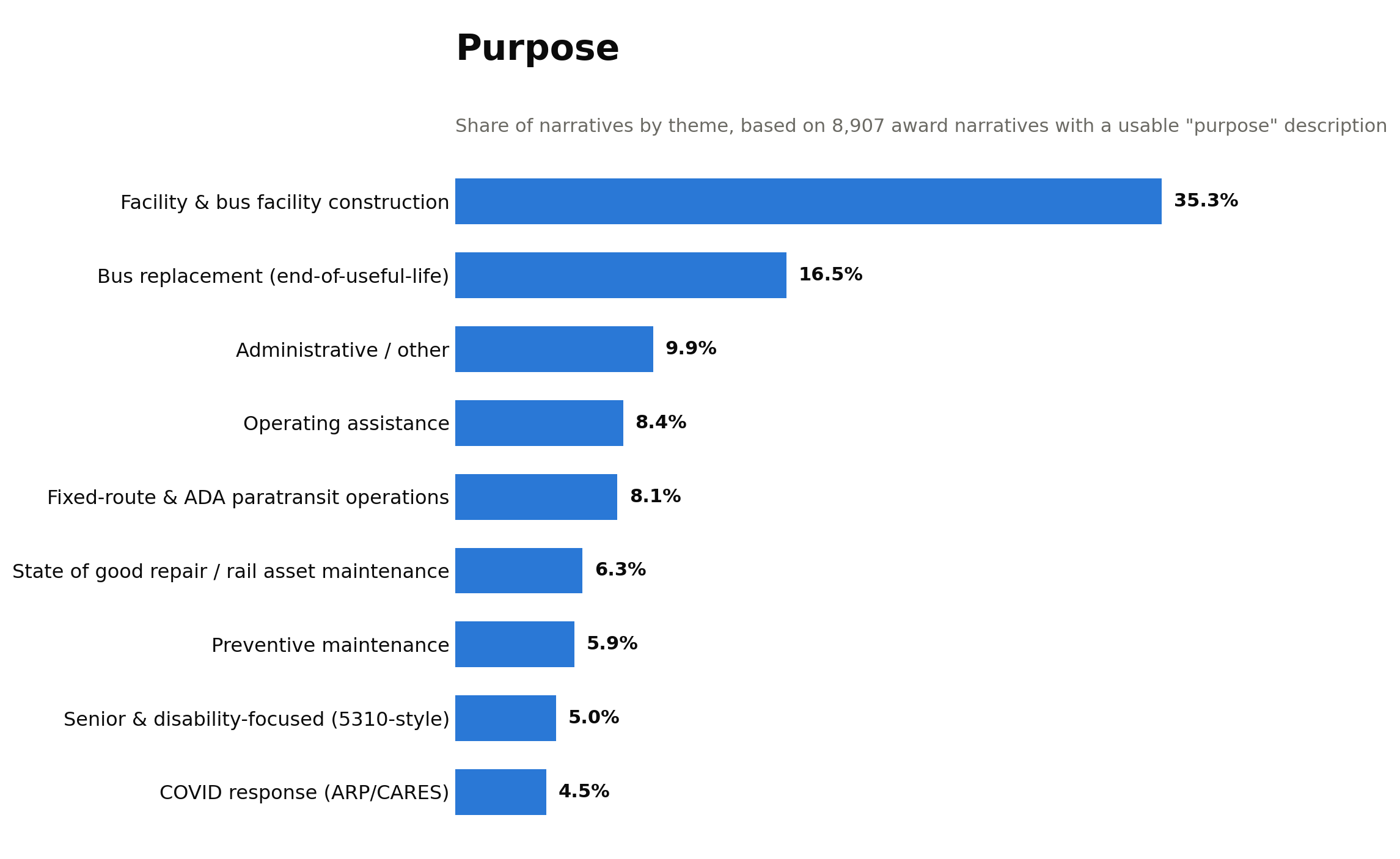
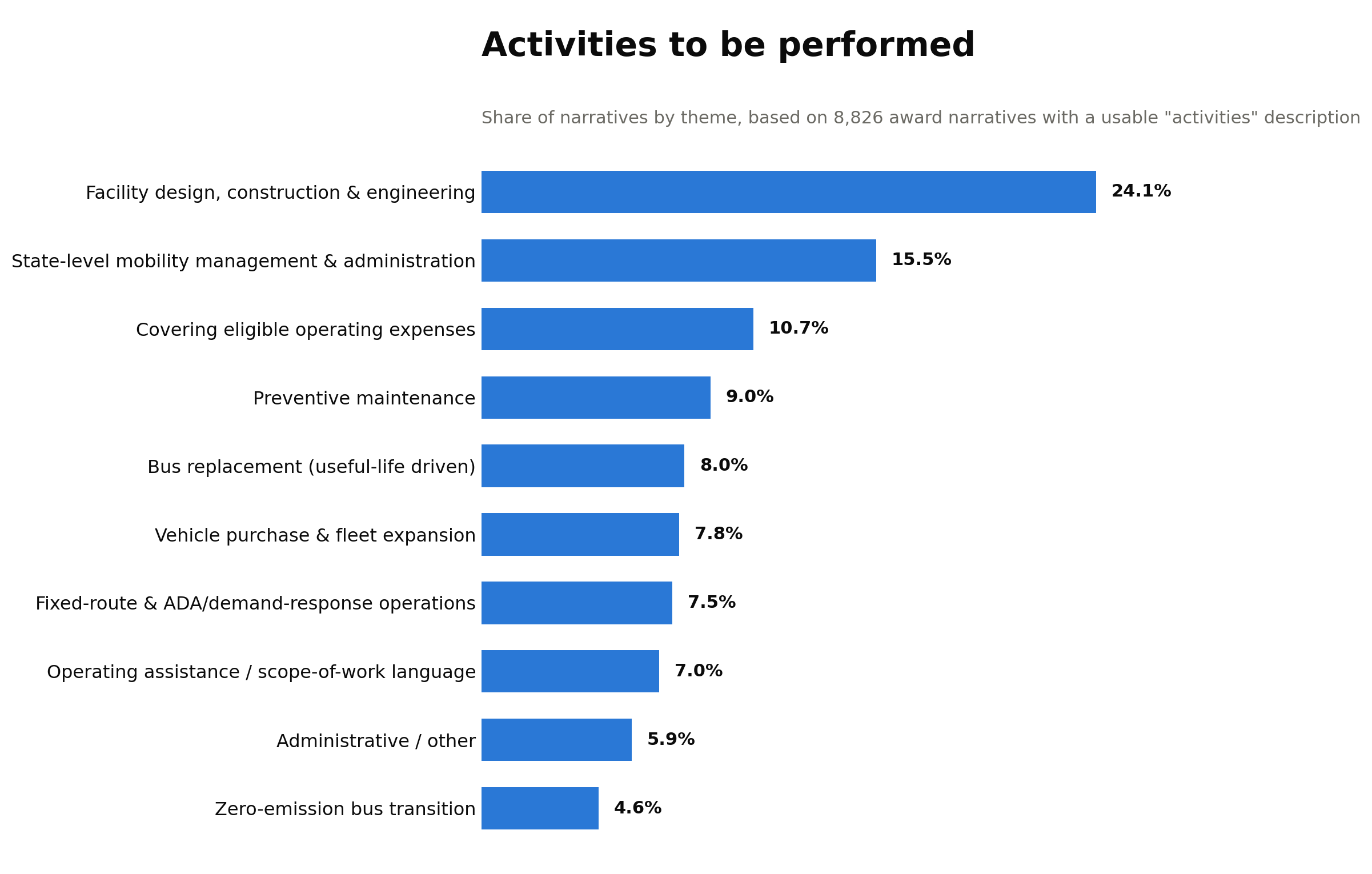
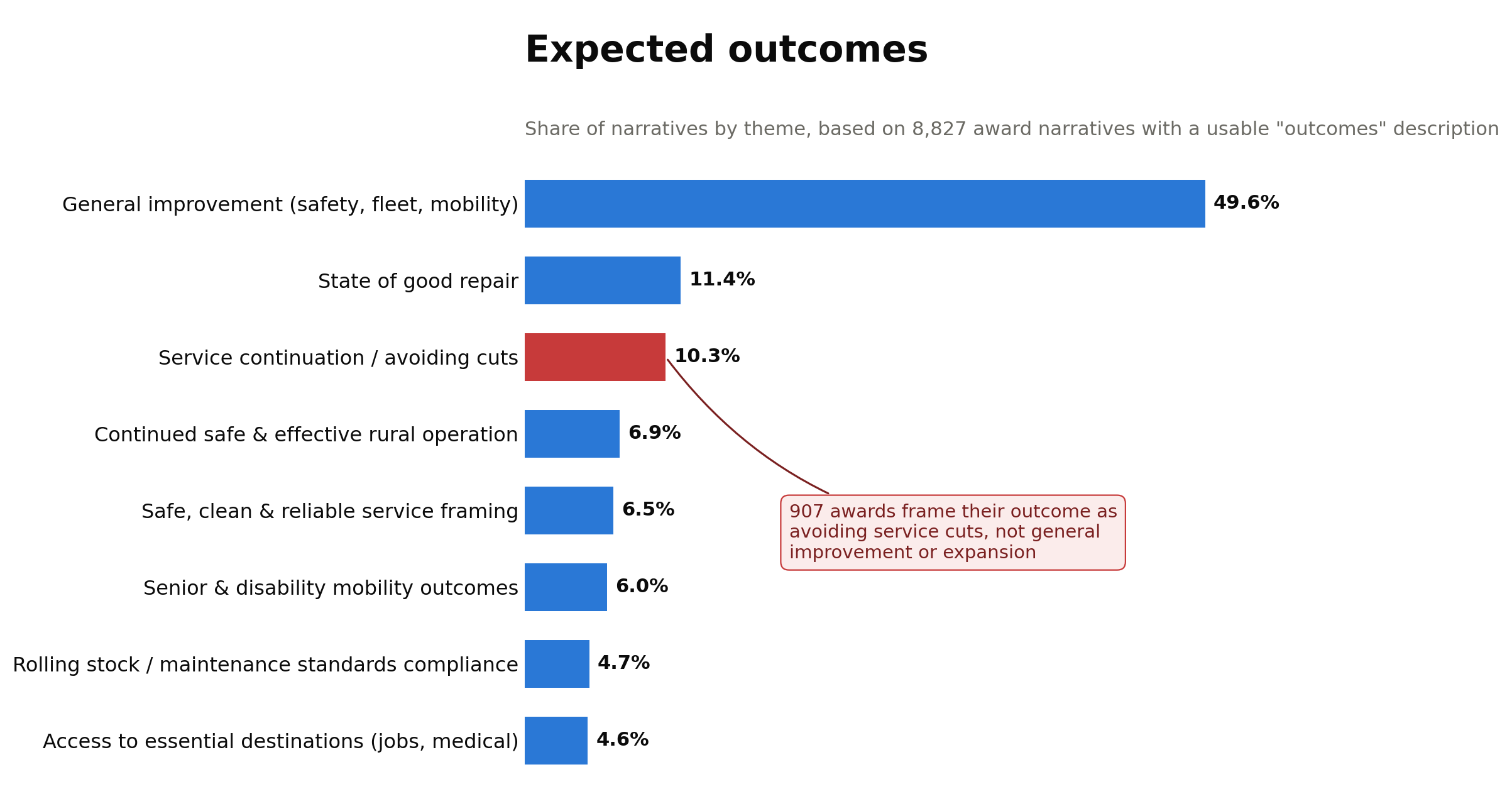
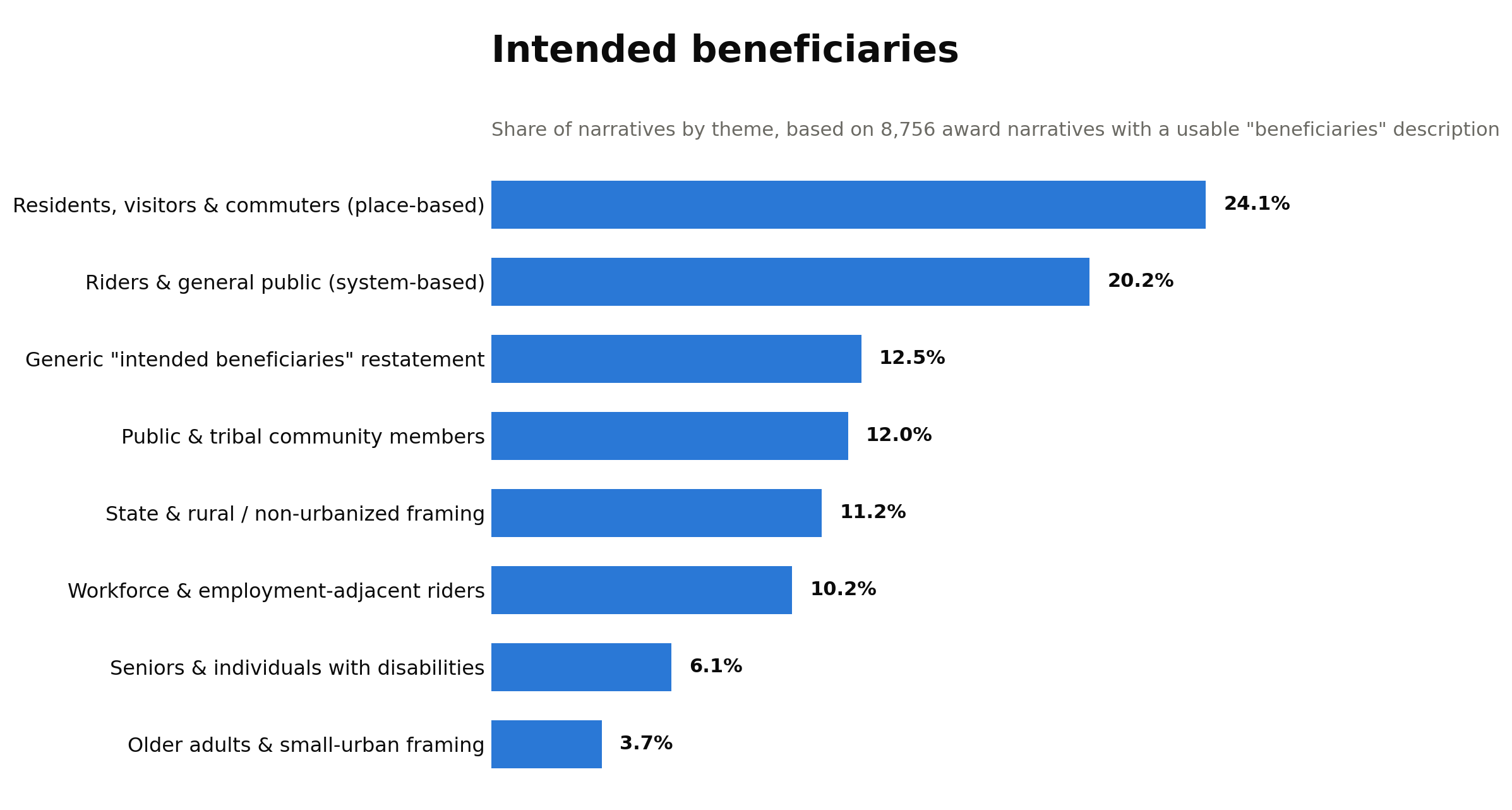
To make the purpose, activity, and outcome themes comparable to one another — and to trace how they connect— I consolidated the raw topic-model output into a shared set of plain-language categories (e.g., folding "preventive maintenance" and "state of good repair" into one "maintenance" bucket), then cross-tabulated awards by their dominant theme at each stage to see how purposes typically translate into activities and outcomes. The Sanky chart below builds a logic model where purpose, activities, and outcomes are connected across themes.
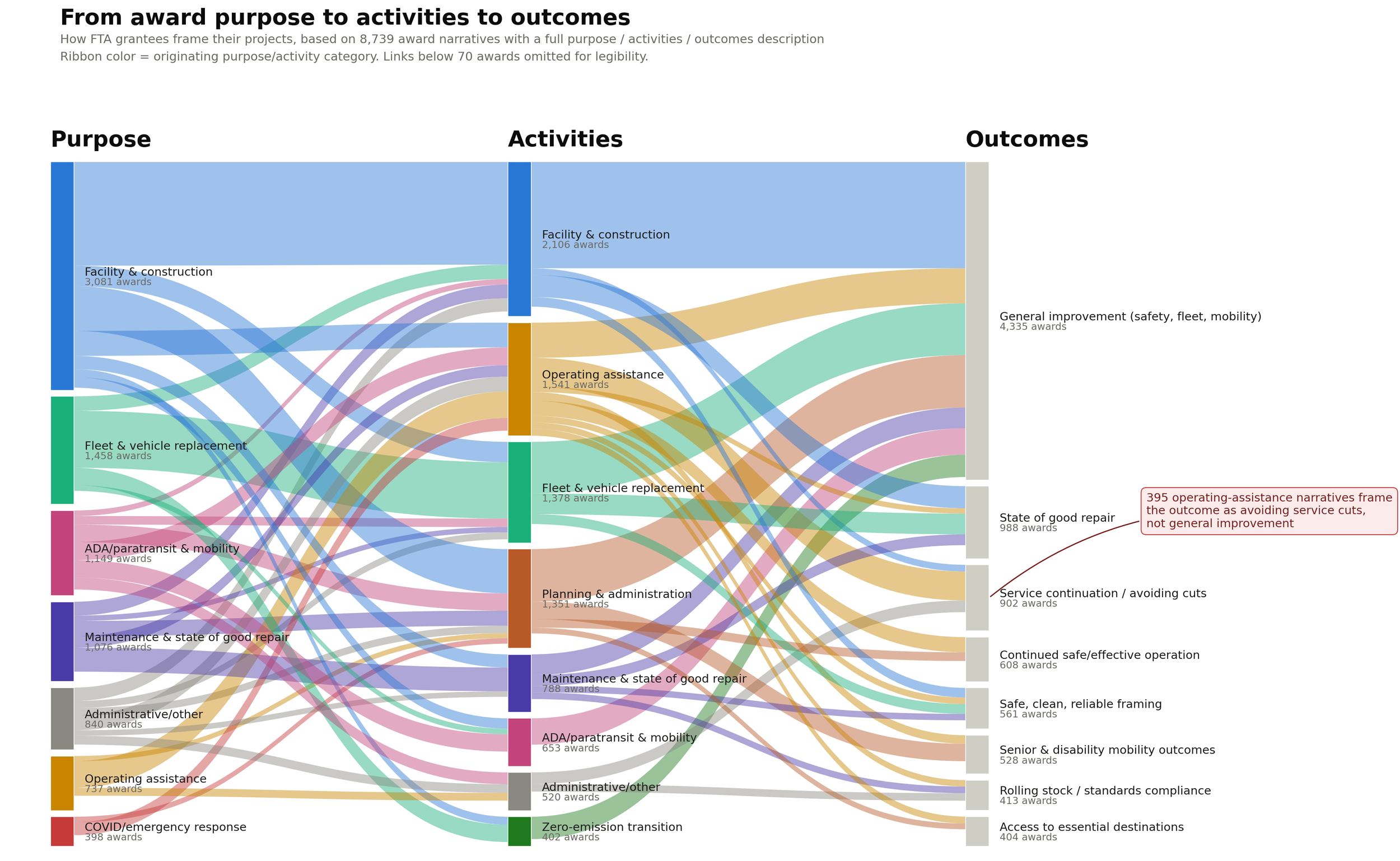
This analysis reveals something valuable and something missing. The valuable thing: the award narrative framework, now in its fourth year, is producing a rich and analyzable portrait of what the federal transit program sets out to accomplish. The troubling thing: we have this 'before' picture in remarkable detail and no 'after' picture at all. We know what transit agencies said they would do. We have no systematic record of whether they did it, whether the riders they named as beneficiaries experienced what was promised, or what any of them learned in the attempt. The reauthorization before Congress now is the moment to require that the 'after' picture by taking advantage of the same pipeline that already produces the 'before.'
Closing the Loop
Very few, if any, new systems or procedures need to be put in place to make the “after” updates possible. Transit grant recipients can take advantage of the same framework and IT infrastructure currently in place for the original narratives to close the loop once the period of performance has ended.
OMB’s Uniform Guidance requires recipients to submit final performance reports and close out awards within 120 days after the end of the award’s period of performance. (The median period of performance for transit grants is just over three years).
To implement OMB guidance, FTA has created a process in its TrAMS system for grantees to amend their awarded grant. The current process is mainly a bookkeeping exercise, where agencies submit final financial statements, provide updates on project milestone completion, and agree to return any unspent funds to the Federal coffers. As part of this process, recipients can open and edit their original narratives in the TrAMS system. Once they do, they will see the same fields as before, with their ex-ante narrative present.
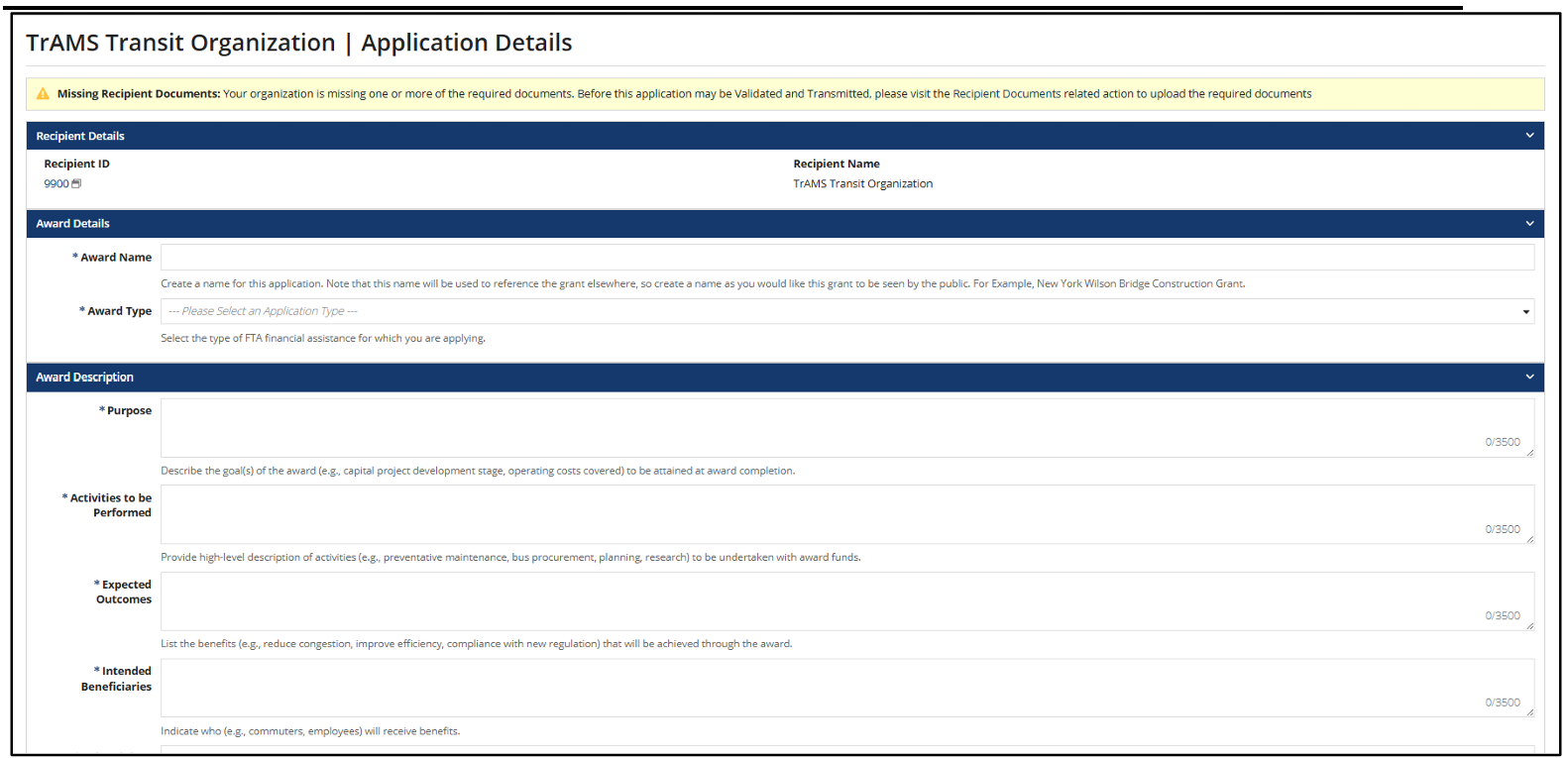
During grant closeout, the original, ex-ante narratives are visible and can be added to or replaced by ex-post narratives without compromising the original information.
Grant recipients can use the same narrative fields for their ex-post account. Updates could follow the same structure and character limitations as the original narratives but with new guidelines that promote reflection and organizational learning. Here is a notional side-by-side:
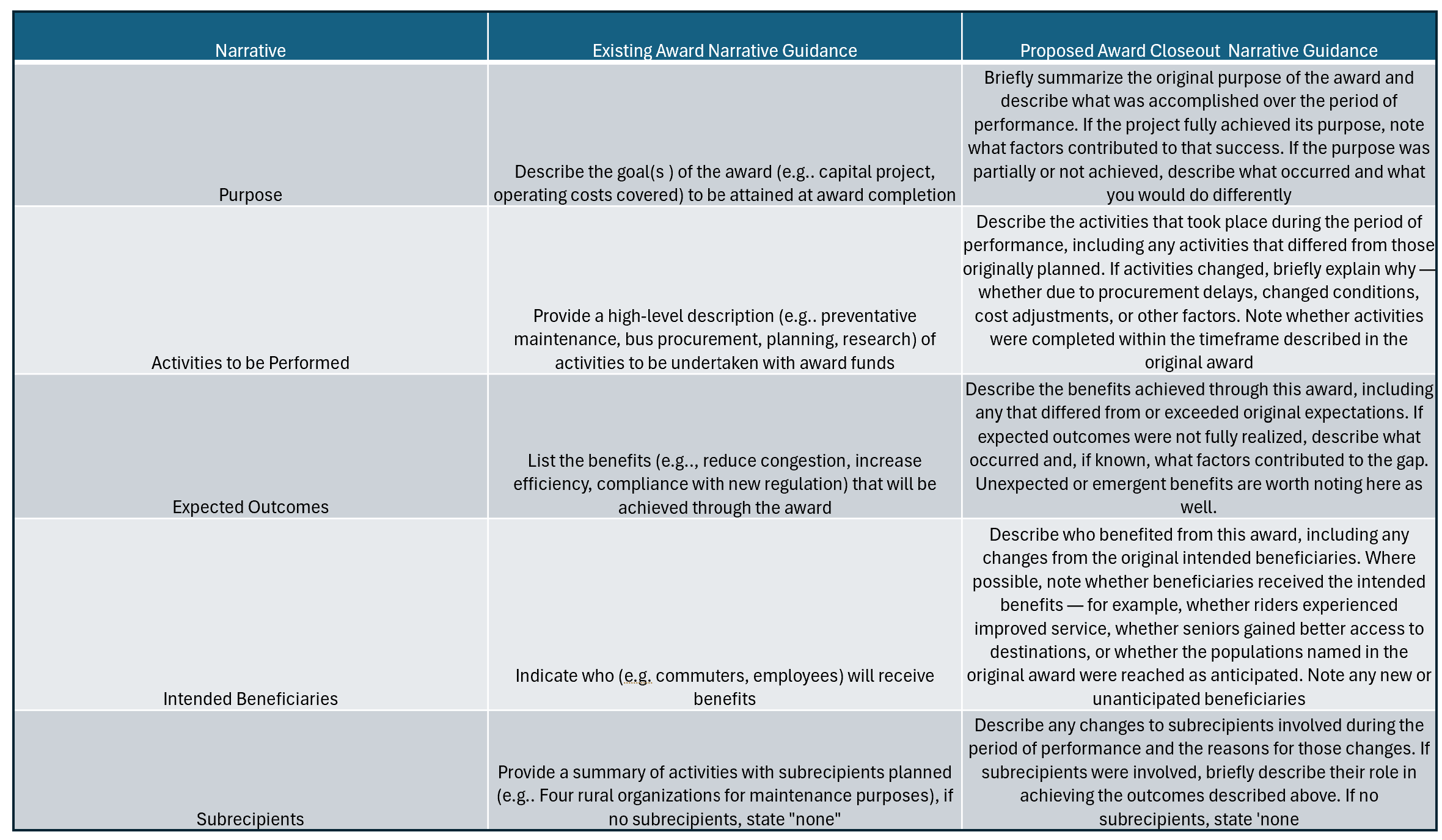
All closeout amendments are reviewed by a regional FTA grant manager before the award can be closed and amendments can be returned with edits to grant recipients, a process that allows for quality control and allows Federal staff who work closely with grantees to absorb the lessons learned. After FTA closes the award, the closeout amendment, as well as the new narratives, are posted to www.usaspending.gov. Critically, the ex-post narrative information is posted, in addition to, not in place of, the ex-ante narratives ensuring that new narratives do not overwrite the original ones and providing a clean audit trail between original promises and reported outcomes.
Precedent
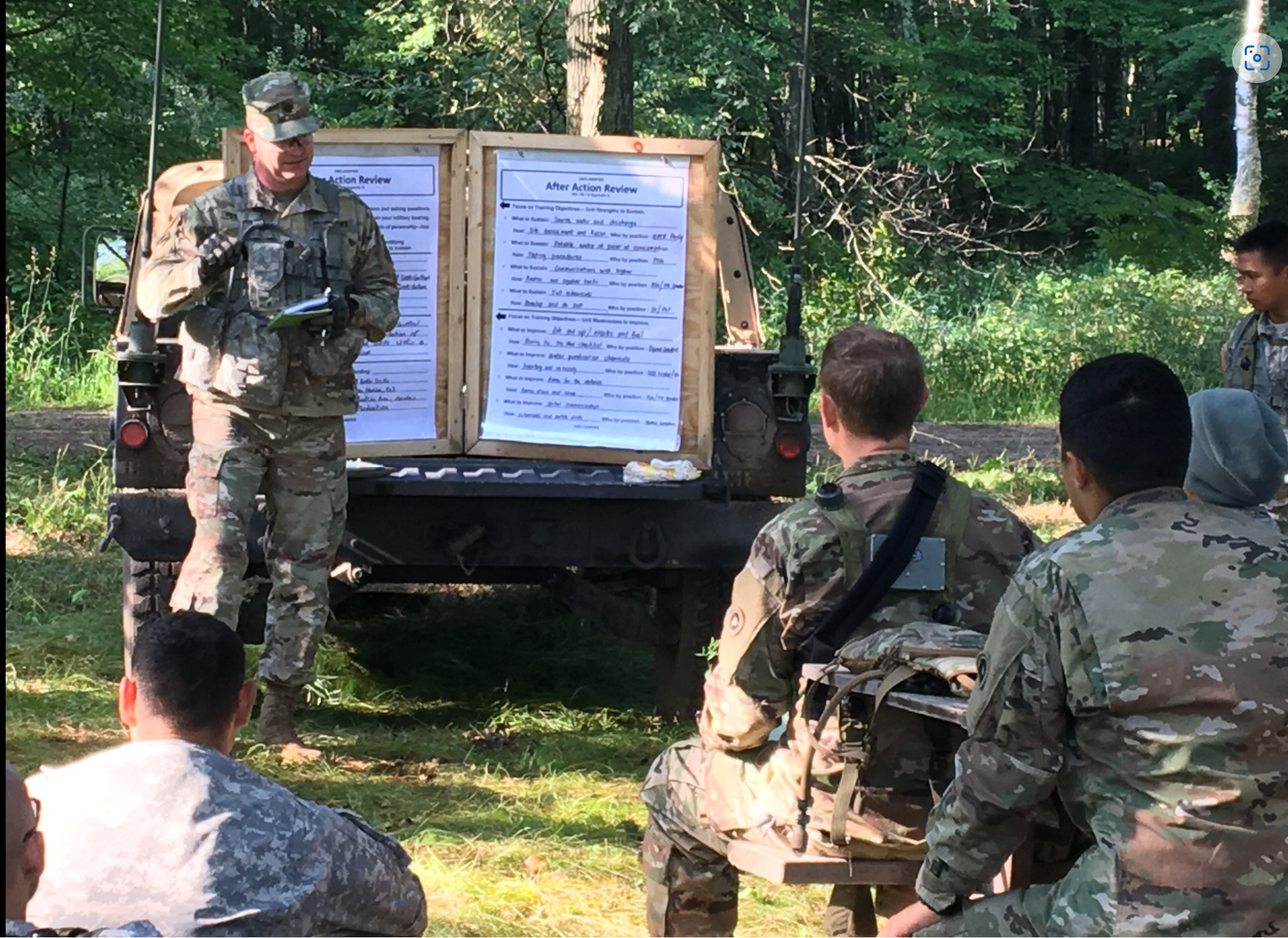
1-337 conducting an After Action Review for an Army Reserve unit at Camp Ripley during CSTX 86-17-03. Source: Wikipedia
Current law includes a precedent for comparing transit intentions to results for America’s largest transit projects funded under the Capital Investment Grant (CIG) grant program, which provides $3.3 billion per year for new transit lines, extensions, and core capacity improvements. A provision in this program calls for a Before-and-After Study requirement that analyzes the impacts of the new fixed guideway capital project on transit services and transit ridership, evaluates the consistency of predicted and actual project characteristics and performance, and identifies sources of differences between predicted and actual outcomes (see 49 USC 5309(k)(1)). It has been in the law in one form or another since 2005.
Congress has already agreed that award-level before-and-after evaluation produces public value — for New Starts, Small Starts, and Core Capacity. This principle should extend to other federal transit investments.
My proposal also draws inspiration from a broader organizational learning practice that is used in the U.S. armed forces and has become commonplace in organizations nationwide: the after-action review (AAR)
In the early 1970s, the United States Army was doing some uncomfortable self-examination based on its performance in the Vietnam War. Army senior leaders identified a gap between how units planned to perform and how they actually performed under real conditions. The gap was not primarily a training problem — it was a learning problem. Soldiers and units completed missions, but the knowledge generated by those missions was evaporating. No structured mechanism existed for capturing what had actually happened, comparing it to what was supposed to happen, and turning that gap into something useful for the next unit that faced the same situation.
The Army's answer was the After Action Review. The process was formalized as a core training tool to enhance unit readiness and adaptability. It became institutionalized through the National Training Center at Fort Irwin, California, where it became the Army's primary learning mechanism. The concept was straightforward enough to be memorable: four questions asked after every significant event — what was supposed to happen, what actually happened, why was there a difference, and what should we sustain or improve.
Under the AAR, the people who ran the mission conduct the review of the mission. Insiders reflect on their own experience. AARs are also conducted at the level of the action itself — the squad, the platoon, the company. A unit learns from what it did.
Major corporations began to use the AAR when former military leaders joined their management teams or boards of directors, drawn by the flexibility and adaptability of the process. It has since been adopted by firefighters, public health emergency responders, and hospital systems.
The relevance to federal grant management is direct. Every federal transit grant begins, as we have seen, with a structured statement of intent — the purpose, activities, intended outcomes, and named beneficiaries. That statement is the equivalent of the mission brief. What the grant management process currently lacks is the institutional equivalent of the After Action Review: a structured occasion, at mission's end, for the people who ran the project to compare what they intended against what occurred, explain the gap, and record what they learned before it disappears. The AAR principle says that knowledge belongs in the record. The grant closeout narrative proposed here is the mechanism for putting it there.
Devolution
A structured after-action evaluation would do more than advance bi-partisan goals for transparency and accountability in publicly funded investments, it would create an epistemic shift that values “bottom up” knowledge creation drawn from the insights and lived experiences of people closest to the work.
What I’m proposing is similar to what organizational learning theorists call reflective practice — the idea that the people doing the work are the richest source of knowledge about it, and that the point of evaluation is to surface and organize what they already know rather than to have outsiders discover it. The transit agency staff who implemented a Federally funded bus purchase knows, or at least has an educated guess, about why the project stayed on schedule or slipped, why costs came in under or over budget, what assumptions turned out to be correct, and which were wrong. Asking the agency to reflect on them at closeout is creating a structured occasion for knowledge that already exists inside to become visible and usable.
This is not how most program evaluation takes place. The status quo relies on top-down reviews sometimes undertaken by Federal agency staff but more often conducted by contracted consultants or agencies like the Government Accountability Office (GAO) or Department’s Offices of Inspector General (OIG). You might think of this group as a “priesthood” who have acquired specialized knowledge of the discipline of program evaluation and have been given exclusive license to carry out the work.
The priesthood typically descends on Federal agencies and grant recipients, applies standardized methodologies and produces findings and recommendations that the agencies experience as external judgments, regardless of whether or not they find the conclusions are useful. This model can produce independent conclusions and may uncover insights not immediately apparent to people working closely on the issues at hand, but it can also be expensive, slow, epistemically limited (the evaluators don't know what the recipient knows), and sometimes resented.
A cursory look at Federal transit programs during the current authorization helps clarify the top-down methodology and the limits of current practice.
Since 2021, GAO and the DOT OIG have produced several reports touching on federal transit program delivery and evaluation. (See GAO-25-107455: Rural and Tribal Transit — FTA Should Evaluate Its Efforts (September 2025), GAO-24-106847: Nonemergency Medical Transportation — Leading Practices Would Help FTA Evaluate Its Pilot Program (September 2024), GAO-25-107104: WMATA — Actions Needed to Evaluate Capital Investment Outcomes (November 2024), OIG: FTA Did Not Verify TAM Performance Target Progress Prior to Awarding CIG Grants (December 2025).
Almost none of these reports evaluates whether the program is delivering high quality service to users. Instead, they answer a narrower set of questions: Did DOT follow its own selection processes? Did FTA verify compliance with financial management requirements? Did recipients use funds for eligible purposes? The reports that come closest to outcomes evaluation either find that FTA hasn't built the infrastructure to evaluate its own programs, or that the evaluation machinery that does exist is structurally incomplete.
When you’re a hammer, everything looks like a nail. GAO and OIG are structurally incapable of recommending anything other than better top-down evaluation, because their institutional purpose is to hold federal agencies accountable to federal standards. When GAO finds that FTA hasn't formally assessed whether its rural transit assistance efforts are effective, the tool GAO has is to recommend that FTA assess itself better. When OIG finds that FTA didn't verify TAM progress before awarding CIG grants, the remedy in OIG's toolkit is to tell FTA to verify more rigorously. The oversight apparatus is designed to produce recommendations directed at federal agencies, so every finding produces a recommendation about what a federal agency should do differently. The possibility that the people running transit systems in rural Montana or tribal New Mexico might be the best evaluators of whether their grants worked is simply outside the frame.
Evaluation agencies like the GAO and the OIG can play an important role in holding executive branch agencies’ feet to the fire and I’m not arguing against their work. In fact, devolved after-action reviews at the grant level would generate the kind of information those oversight bodies keep asking Executive agencies to produce, and would do so from the ground up rather than the top down.
The rural/tribal report wants FTA to assess whether its assistance efforts helped communities access and use funds better. If every rural transit recipient was required at grant closeout to answer: what did we intend to do, what happened, why, what did we learn, agencies like FTA would have a corpus of self-reported evidence from which it could actually conduct the systematic assessment GAO keeps recommending. The ICAM report wants FTA to develop an evaluation plan including an assessment methodology, criteria for scalability, and a data analysis plan. The recipient-level closeout narratives would be the raw data for exactly that analysis — without requiring FTA to build a parallel evaluation infrastructure from scratch.
Both approaches offer accountability. The after-action narrative process envisions a different kind of accountability, one grounded in self-knowledge rather than external surveillance. And it's likely to produce more durable learning precisely because the recipient owns it.
Objections
Change doesn’t come easily, and people considering this proposal may have concerns. This section responds to three likely objections: 1. The proposal does not belong in a surface transportation authorization; 2. The evaluations produced would be self-serving or incomplete; 3. The new requirements would add to state and local agencies’ workloads.
Since I’m proposing changes to grants reporting rooted in prior OMB memos and its Uniform Guidance at 2 CFR 200, shouldn’t the path to change run through a new OMB memo or change to the Uniform Guidance? And shouldn’t these reporting changes apply to all Federal awards, not just surface transportation or transit grants? This is a valid point, and I’ve submitted a version of this essay to the comments docket on OMB’s proposed sweeping changes to 2 CFR 200. (See OMB-2026-0034. Over 341,000 comments were submitted and I’m not holding my breath that mine will rise to the top).
Surface transportation law is also a reasonable and historically well-established home for this kind of change. Congress has used reauthorization bills to build performance measurement requirements into federal transit law before, and each time it has done so, the requirements have proven durable and consequential. The current law already requires transit agencies to maintain Transit Asset Management plans that measure the condition of their fleets and facilities and set targets for bringing assets into a state of good repair. It requires agencies to develop and update Public Transportation Agency Safety Plans with measurable targets for reducing fatalities, injuries, and safety incidents. And as described above, it requires recipients of major capital investment grants to conduct before-and-after studies comparing predicted and actual project outcomes.
These frameworks measure the condition of transit assets and the integrity of agency processes. They ask whether the buses are in good shape, whether safety plans are in place, whether a major capital project performed as projected. What they do not ask — what no existing framework asks — is whether riders received the high-quality service the law promises them. That goal, stated plainly in the U.S. Code as a primary purpose of the entire federal transit program, lacks a corresponding evaluation structure. Transit Asset Management serves the state-of-good-repair goal. The safety planning requirement serves the safety goal. The closeout narrative proposed here would serve the high-quality service goal — the one that is most directly about people, and the one that has gone unevaluated the longest.
Executive branch memos and regulations can be updated and repealed, but statutory language tends to be more durable across administrations. The longer a closeout narrative requirement remains in law, the more narratives accumulate in the public domain — and more information, gathered consistently over time, produces more meaningful insight. A requirement embedded in surface transportation reauthorization could also serve as a model and proof of concept for other federal programs, extending the transparency framework that FFATA and the DATA Act built into the back end of the grant lifecycle government-wide.
Another reasonable concern is that agency staff would not provide a detailed and forthright self-evaluation, especially when projects didn’t go according to plan. After all, agency project managers are not impartial, outside evaluators. Some may be tempted to embellish results or make causal links to outcomes that are hard to prove or are influenced by exogenous factors (e.g. “our new bus purchase dramatically improved air quality across the region”). Other agencies may worry that the process will devolve into a blame game or may fear retaliation or future funding withheld once critical narratives are posted via www.usaspending.gov.
Here is where volume provides a benefit. A single transit agency’s closeout narrative might be self-serving or incomplete. But if you have one thousand transit agencies all answering the same five questions at closeout over five years, the aggregate corpus becomes analyzable in ways that a single narrative cannot be. Narratives published at grant closeout do not run the risk that honesty will result in funding being withdrawn because all Federal funds have already been expended or returned. Regarding limits to future funding, almost 80% of transit funding is allocated via statutory formulas based on demographic information or service quality. These dollars cannot be steered away from agencies who have reported challenges. Funding under competitive programs may include a mechanism for Federal officials to consider past performance. Maybe I’m naïve but I believe that an agency that has experienced setbacks implementing transit projects and has documented and learned from these challenges is in a better position to do better in the future than one that has not, all else being equal. The proposal could also include language that the results of agency AARs would not be used in Federal oversight reviews or trigger additional audits.
What about the extra workload? Yes, completing an AAR at the time of grant closeout would require time and effort above and beyond the status quo. In the case of transit grants, most agencies close out between one to six awards per year, so AARs would take place periodically, not constantly. An AAR could consist of a team of people meeting in a conference room for a few hours, or a single grants manager taking an hour to write down their reflections (agencies would have wide leeway to determine what process works best for them). A narrative word limit would keep things concise. The process would not necessarily require supporting documentation or detailed statistical analysis.
But more importantly, completing an AAR is some of the most meaningful professional work a grant manager can do, and substantively different from compliance reporting. Reporting financial expenditures, tracking milestone completions, and certifying that funds were spent on eligible activities are necessary acts of administrative hygiene. An after-action narrative produces something else: an account, in the grant manager's own words, of what their agency set out to do and what actually happened. The planner who spent three years shepherding a transit project from creation to completion has a story that deserves to be told, which may be genuinely useful to the colleague who inherits the next similar project, the peer agency considering the same approach, and the community that funded the work and deserves to know what came of it.
Organizations lose knowledge constantly over time: people retire, priorities shift, institutional memory fades. The closeout narrative is a structured act of transmission — a way of ensuring that what was learned doesn't leave when the project manager does. There is also something worth acknowledging about the psychological dimension of reflection. Grants management is relentless forward motion: the next application, the next obligation, the next milestone. A structured pause at project's end to say honestly what happened (what worked, what didn't, what surprised us) is a moment of completion. That matters, both for the people doing the work and for the public record they leave behind.
Civic Virtue
There is a public interest argument for this proposal that goes beyond accountability to taxpayers, important as that is. The corpus of data that would accumulate over time — thousands of honest accounts of what transit agencies set out to do, what they accomplished, and what they learned — would contribute to a shared factual foundation for public decision-making.
We are living through a period in which the shared factual infrastructure that makes democratic governance possible is under strain, where decisions are too often based on anecdote, ideology, or whomever has the loudest voice in the room. In that context, a proposal to require grant recipients to write down what they learned before it disappears is a modest but genuine act of civic participation adding, grant by grant and story by story, to the body of reliable public knowledge that makes good government possible.
